
Moore County Sex Offender Checks
The North Carolina Sex Offender and Public Protection Registry is the main public search channel for Moore County. The North Carolina State Bureau of Investigation maintains the statewide system. Moore County Sheriff's Office personnel receive and update local registrations, while SBI publishes the information after it reaches the state system. That handoff matters. A recent move or correction may not appear at once, so a result is a current public record rather than a permanent statement about where a person is located.
Begin with the search that fits the need. A county search gives a broad Moore County list. An address or current-location search is better for a small area. A name search helps when the person is already known, but the result still requires comparison of photographs and physical details. For suspected nonregistration or a bad address, contact the Moore County Sheriff's Office at 302 S. McNeill Street in Carthage or 910-947-2931. Only fingerprint comparison can establish identity with certainty.
The SBI acceptable-use screen explains the terms a searcher must accept before entering the registry.
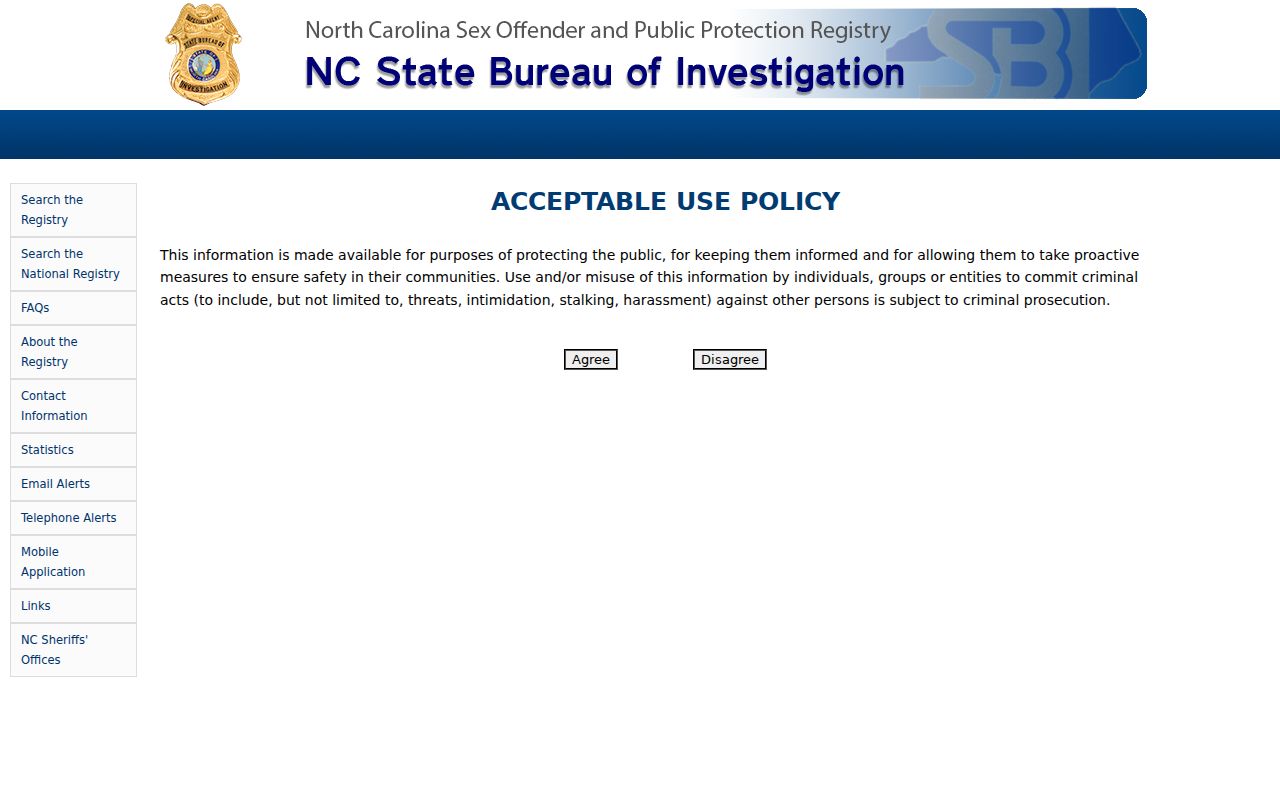
That entry screen places lawful use ahead of every Moore County registry search and sets the tone for responsible community awareness.
Moore County Registry Record Flow
A registry entry has two linked custodians. A registrant reports to the sheriff in the county of residence, and Moore County sends the required data to SBI. The state agency then operates the public registry. The official Moore County Sheriff's Office page supplies the local agency contact. This record differs from an arrest report, court docket, or jail roster. Those files can describe an event or case without proving that the person has a current duty to register. The registry exists for the narrower purpose set by North Carolina Article 27A.
Record flow: Moore County Sheriff's Office › North Carolina SBI › public registry and alert system.
Processing can cause gaps between a report to Moore County and a state update. The official statistics are also approximate because sheriff submissions and SBI processing do not occur at the same instant. Do not turn a current count into a fixed local total. For a suspected move, failed verification, or inaccurate listing, provide Moore County with the profile and the specific fact that appears wrong. The sheriff can check its registration record and route corrected data into the state system.
North Carolina Sex Offender and Public Protection Registry Searches
The official SBI registry search supports several paths into Moore County data. The accessible interface does not establish that every name subfield is mandatory, so avoid guessing at hidden rules. Use one solid fact first, then narrow the results. A county search is useful for general awareness, while a street or map radius search is more precise for a given place.
- Open the SBI registry and acknowledge its acceptable-use terms.
- Select Moore County, enter a known name, or use an address, ZIP, or location search.
- Choose a one-, three-, or five-mile radius when the map or mobile view offers that control.
- Open a likely profile and compare the photo, aliases, physical description, address, and offense information.
| Search Control | Type | Required | Moore County Use |
|---|---|---|---|
| Acceptable Use | Acknowledgment | Yes | Must be passed before a public search |
| Name | Text | Mode dependent | Compare profile details, not name alone |
| County | Geographic | No | Select Moore for a countywide view |
| City or ZIP | Geographic | No | Narrows results within the county |
| Street Address | Address | No | Supports proximity mapping |
| Current Location | Map or GPS | No | Mobile materials support nearby search |
| Radius | Buttons | No | One, three, or five miles |
The registry search form is the official doorway for these Moore County controls.
The interface separates name and place-based methods, which lets a searcher choose between identifying a known person and checking a local area.
Moore County Registry Proximity Alerts
The North Carolina registry alert service lets a subscriber enter more than one North Carolina address and choose a one-, three-, or five-mile zone. An email is sent when the registry receives a reported move into that radius. This is a monitoring tool, not a full criminal-record search. It does not promise notice about a person who is not subject to registration, an unreported move, or data that has not finished processing.
NC SAVAN offers telephone notifications tied to a registrant or ZIP code. Its role is notice, not identity proof or certification. People who travel or live near a state line can also use the national search discussed below. These tools work best together: the Moore County registry shows the current public profile, email alerts watch selected places, and SAVAN supplies another notification channel. Keep the original signup details current so the notice reaches the right address.
The SBI proximity-alert page shows where Moore County residents create and manage local alert zones.
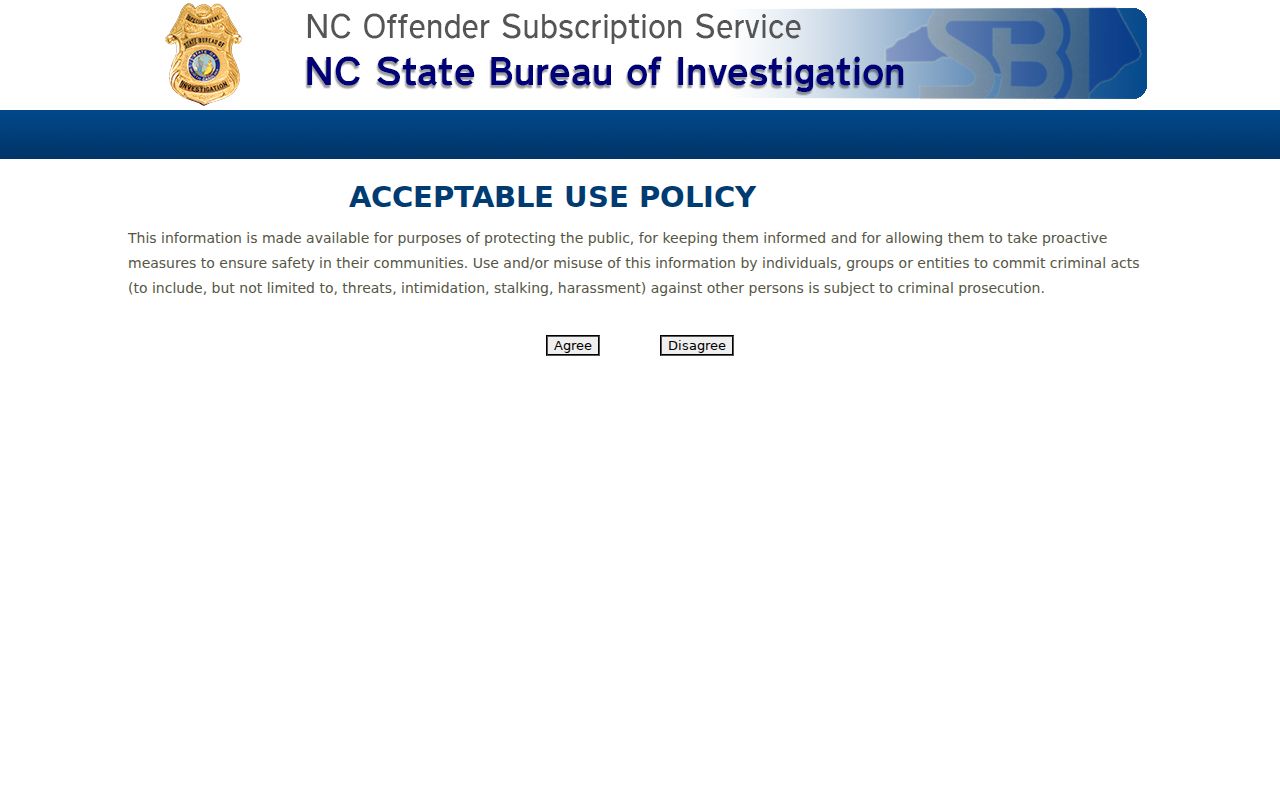
The alert screen turns a static Moore County lookup into continuing notice, while its distance choices keep each subscription tied to a real place.
Registry Profiles: What They Show
A public Moore County registry profile brings identity, location, and offense information into one record. It may display a full name and aliases, current photographs, birth date, sex, race, physical traits, a registered home address, and offense details. Verification or registration status may also appear through the public product. The underlying statutory collection includes more data, but a public description should stay limited to fields the current interface actually displays.
| Name and Aliases | Published names that can help connect records filed under different forms of a name |
|---|---|
| Photo and Description | Current photo plus sex, race, height, weight, eye color, and hair color when displayed |
| Registered Address | The home address most recently reported and processed through the registry |
| Offense Information | Public details about the offense or offenses that support registration |
| Registry Status | Public status and verification information available in the current product |
| Not Public Here | Juvenile delinquency listings and people whose offenses do not require registration |
A photo and several physical traits make a stronger comparison than a shared name. Even then, SBI warns that only fingerprints establish a positive identity. A profile also cannot reveal people who were never detected or whose offense falls outside North Carolina registration law.
Moore County Registry Search Limits
A no-hit is not a clearance. North Carolina excludes juvenile delinquency listings from the public registry, and not every offense triggers registration. Some profile facts are self-reported. Moves, sheriff submissions, and SBI updates can take time, so a recently changed address may lag. These limits explain why the system is useful for awareness but cannot guarantee that no risk exists near a Moore County address.
The official SBI registry FAQ details coverage, reporting, alerts, and limits on the public data.
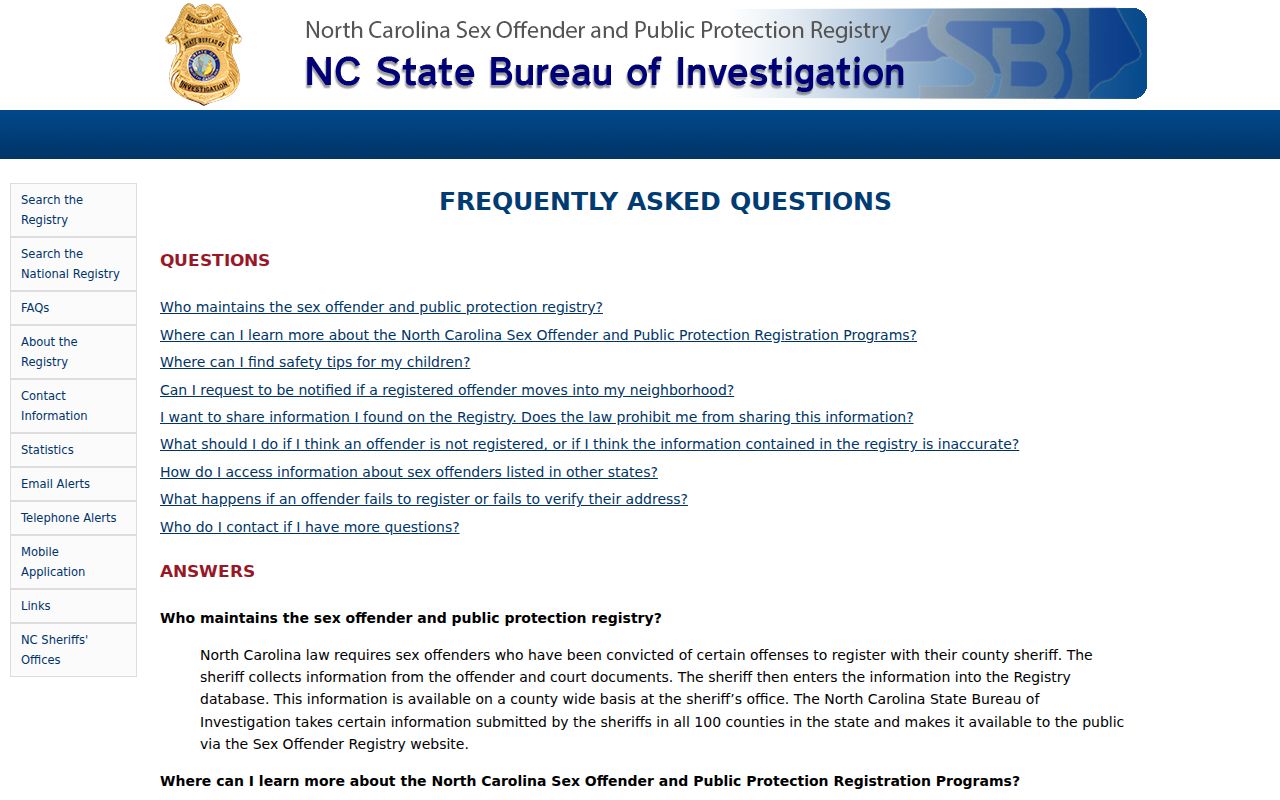
Those official limits help a Moore County searcher read silence cautiously instead of treating an empty result as proof about a person or place.
If a profile appears inaccurate, do not publish a conclusion or confront a household. Note the disputed address or status, then contact the Moore County Sheriff's Office at its published number. The sheriff can check the local registration record. SBI can then publish an update after the contributing information reaches the state system.
Registration Levels and Duties in North Carolina
North Carolina does not present Moore County profiles through a simple public Tier I, II, and III chart. The law instead uses classification and offense-based duties. Ordinary reportable offenders register for at least 30 years and may petition Superior Court after 10 years. That petition opportunity is not an automatic end date. Recidivists, aggravated offenders, and sexually violent predators register for life.
| Registration Track | Duration | Verification |
|---|---|---|
| Ordinary reportable offender | At least 30 years; petition may be possible after 10 | Semiannual |
| Recidivist | Lifetime | Every 90 days |
| Aggravated offender | Lifetime | Every 90 days |
| Sexually violent predator | Lifetime | Every 90 days |
The semiannual form is nonforwardable and must be returned in person within three business days. New residents generally report within three business days of establishing a residence, or after being present for 15 days, whichever occurs first. Failure to register, report an address change, return verification, or truthful completion can be a Class F felony. A duration track should not be used as a personal risk score because an individual's actual duty depends on the governing offense, dates, and legal classification.
Moore County and National Searches
The Dru Sjodin National Sex Offender Public Website adds a cross-state layer. It is useful when an address history crosses North Carolina's border or when a Moore County search alone would be too narrow. NSOPW draws from participating jurisdictions, while the SBI registry remains the direct North Carolina source. Neither system should be treated as a biometric identity check.
The official NSOPW search presents the national route used alongside a Moore County lookup.
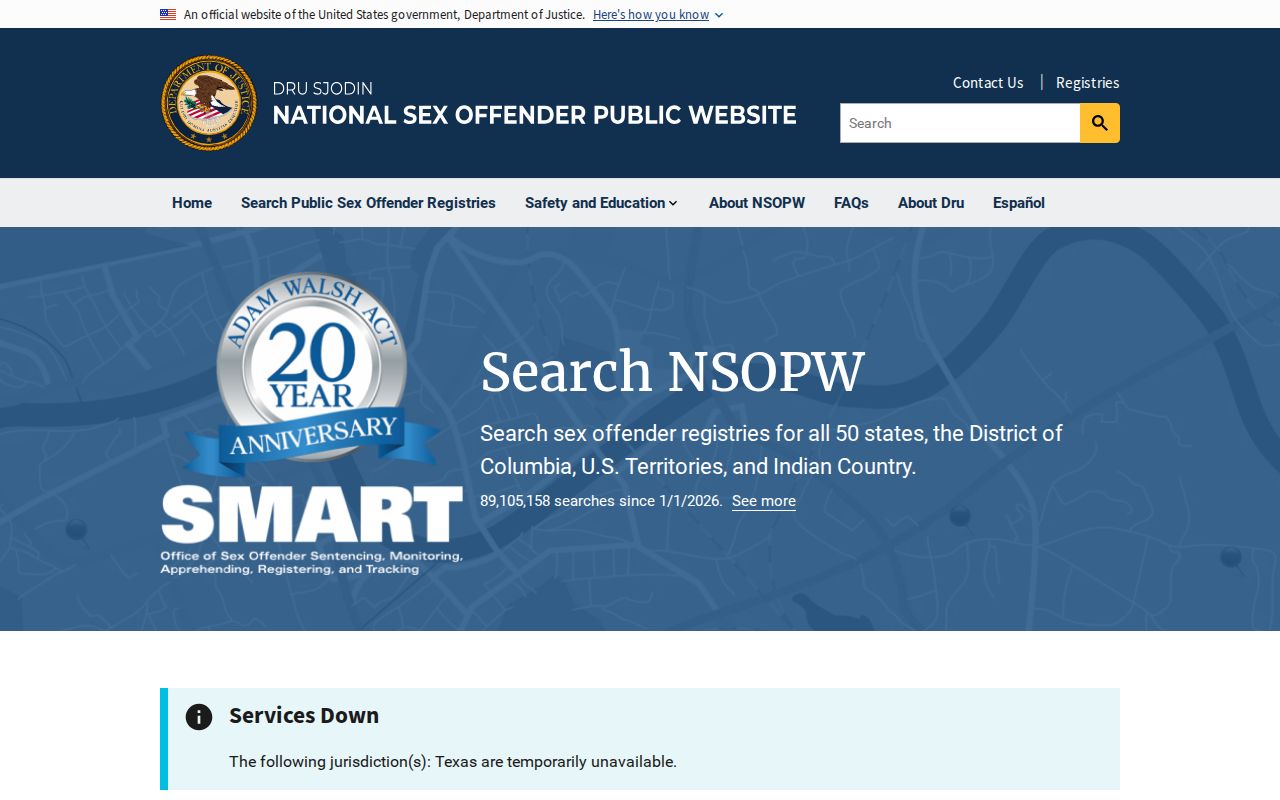
The national interface broadens geographic coverage, but a North Carolina result should still be read against the SBI profile and Moore County reporting channel.
Search the state and national systems separately when a move involves more than one jurisdiction. Compare photographs, aliases, and dates rather than relying on a name match. If the facts conflict, report the issue to the relevant registry office instead of deciding which profile is correct. That protects both public safety and accurate identification.
Moore County Registry Verification Cycles
Verification is a schedule, not a live tracker. An ordinary registrant reports at the anniversary point and again six months later. A person in a lifetime category reports every 90 days. Moore County receives those local contacts, and SBI publishes the resulting state record. A profile can therefore be current as of its last processed update without describing a person's location at every moment.
The SBI registry overview explains the state program that receives Moore County registration information.
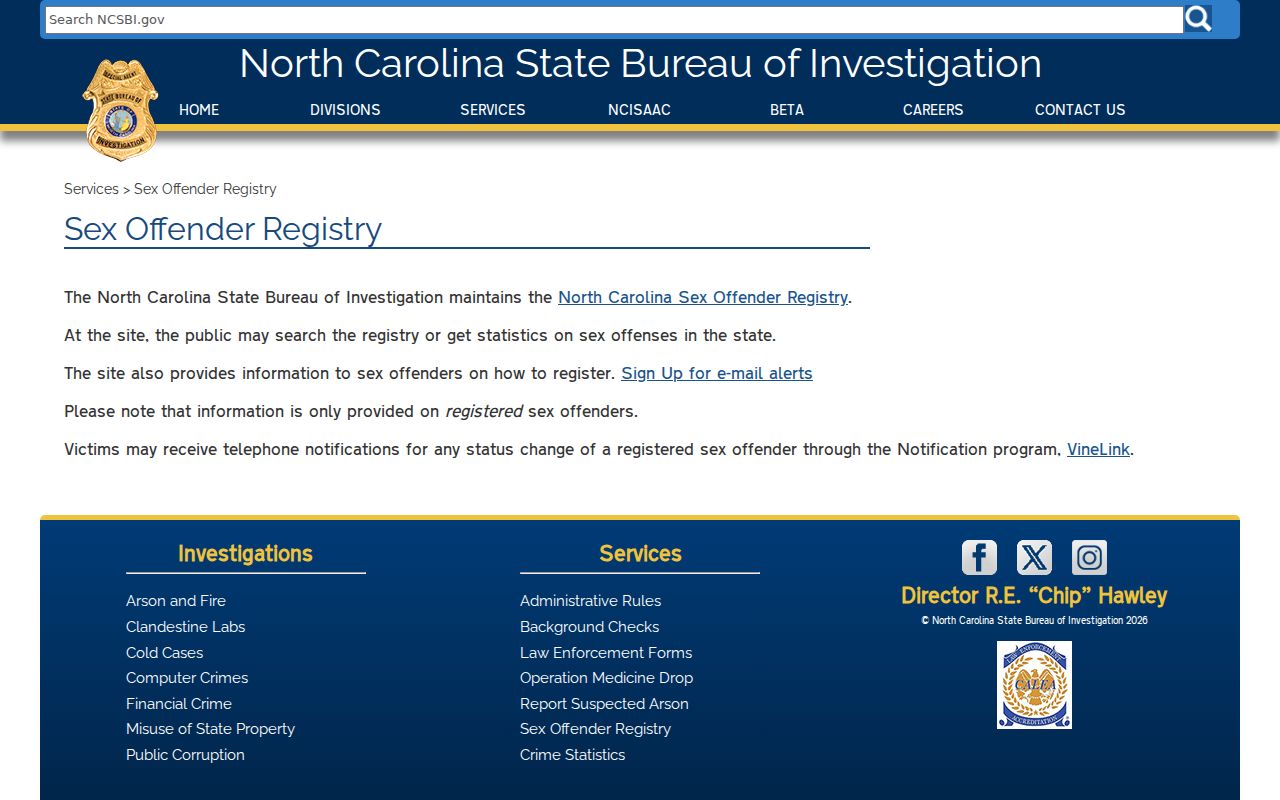
The overview connects local sheriff verification with the statewide record, clarifying why both agencies have a role in a Moore County entry.
Report suspected noncompliance to the Moore County Sheriff's Office rather than testing the address or contacting the registrant. The Moore County government hub is another official route to current county contacts. Give staff the public profile, location concern, and observed error. That lets trained personnel compare the public data with the registration file and take any action that the facts and law support.
Using Registry Information Lawfully
North Carolina publishes registry information for public safety and community awareness. It is appropriate to learn about an area, set an official proximity alert, or report a suspected data problem. It is not a license to follow, threaten, intimidate, stalk, or harass a person or anyone in that household. A profile should never be republished as a claim about conduct that the record does not show.
Registry misuse warning: Under North Carolina General Statutes Chapter 14, Article 27A and the SBI acceptable-use notice, threats, intimidation, stalking, harassment, or crimes based on registry information may be prosecuted. Use the record only for lawful safety and awareness purposes.
The SBI disclaimer appears before the search for this reason. Local concerns should go to Moore County law enforcement. Immediate danger belongs with emergency services. Suspected listing errors or nonregistration belong with the sheriff's published office number. Those channels preserve evidence and place the issue with the agency that can lawfully verify it.