
Criminal Court Cases in Moore County
Moore County criminal cases are heard in two divisions at the same courthouse. District Court handles misdemeanors, infractions, and the first steps in felony matters. Superior Court tries felonies after the case advances. The Moore Clerk of Superior Court keeps records for both divisions, so a reader does not need a different record office when a felony moves from preliminary proceedings to Superior Court.
The record counter is at the Moore County Courthouse, 102 Monroe Street, Carthage, NC 28327. It is open Monday through Friday, 8 a.m. to 5 p.m. The main Clerk number is 910-722-5000, and mailed requests go to PO Box 936, Carthage, NC 28327. The District Attorney prosecutes cases, but the Clerk is the custodian for court files and certified records.
Moore County Court Records Hub
The official Moore County court services page brings together calendars, contacts, payment guidance, and the path into eCourts. It also records the county's October 14, 2024 move into Odyssey and the statewide Portal. That date matters when reading older entries because converted data may not look the same as a new electronic filing.
The official court hub is shown below. Its county location filter helps keep a name search centered on Moore County rather than a similarly named party elsewhere in North Carolina.
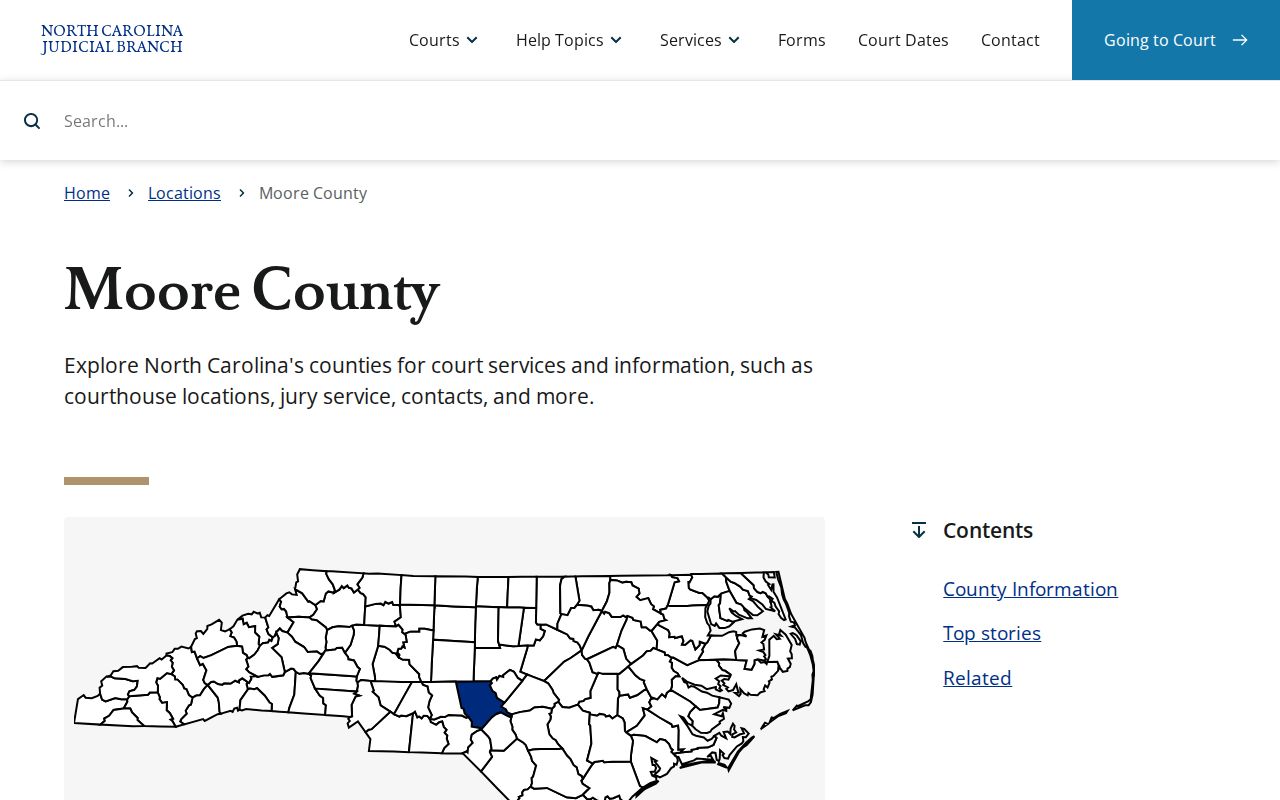
The location page is also the safer starting point for current schedules because hearing dates can change after a docket entry is posted.
Moore County Case Record Searches
The free North Carolina eCourts Portal is the main remote channel. Smart Search finds case records, Search Hearings focuses on when and where matters are set, and NC Judgment Search narrows judgment results. A free account is not required for an ordinary anonymous search. Registration mainly supports saved cases, while elevated access requires legal authority.
- Open Smart Search and select Moore County or the correct location filter.
- Search with a party name, case number, citation number, attorney name or bar number, business name, cross-reference number, or nickname.
- Compare the county, case number, dates, and available party details. A matching name alone is not a confirmed identity.
- Open the Register of Actions and review events, hearings, dispositions, documents, and financial information in context.
- Use a courthouse terminal or ask the Moore Clerk for an older file, paper copy, certified copy, or official county search.
The Portal offers several search keys, and the official material does not mark every key as required. Do not invent wildcard rules or assume that a missing date field blocks a search.
| Portal field | Search type | Required | Use in Moore County |
|---|---|---|---|
| Party or business name | Text | Not stated | Use county and other details to split common names. |
| Case or record number | Text | Not stated | Best key when copied from a notice or prior docket. |
| Citation number | Text | Not stated | Connects a citation to its filed court record. |
| Attorney or bar number | Text | Not stated | Useful for cases tied to known counsel. |
| Nickname or cross-reference | Text | Not stated | Can find a record missed by an exact legal name. |
| Location and status | Filter | No | Narrows results to Moore County and the needed posture. |
Moore County Terminal Access
When Portal falls short, the courthouse public terminal is a separate and useful channel. It can search statewide criminal and infraction records by defendant name, case number, or victim or witness name. A user may email noncertified results without charge, though printing can carry a cost. Paper files remain in the county where the case was filed, so the Moore Clerk handles Moore County source documents.
The Judicial Branch explains the differences among remote, terminal, and paper access on its obtaining court records page. That source is shown below because a Portal no-hit may call for an in-person terminal search or review of an older paper file.
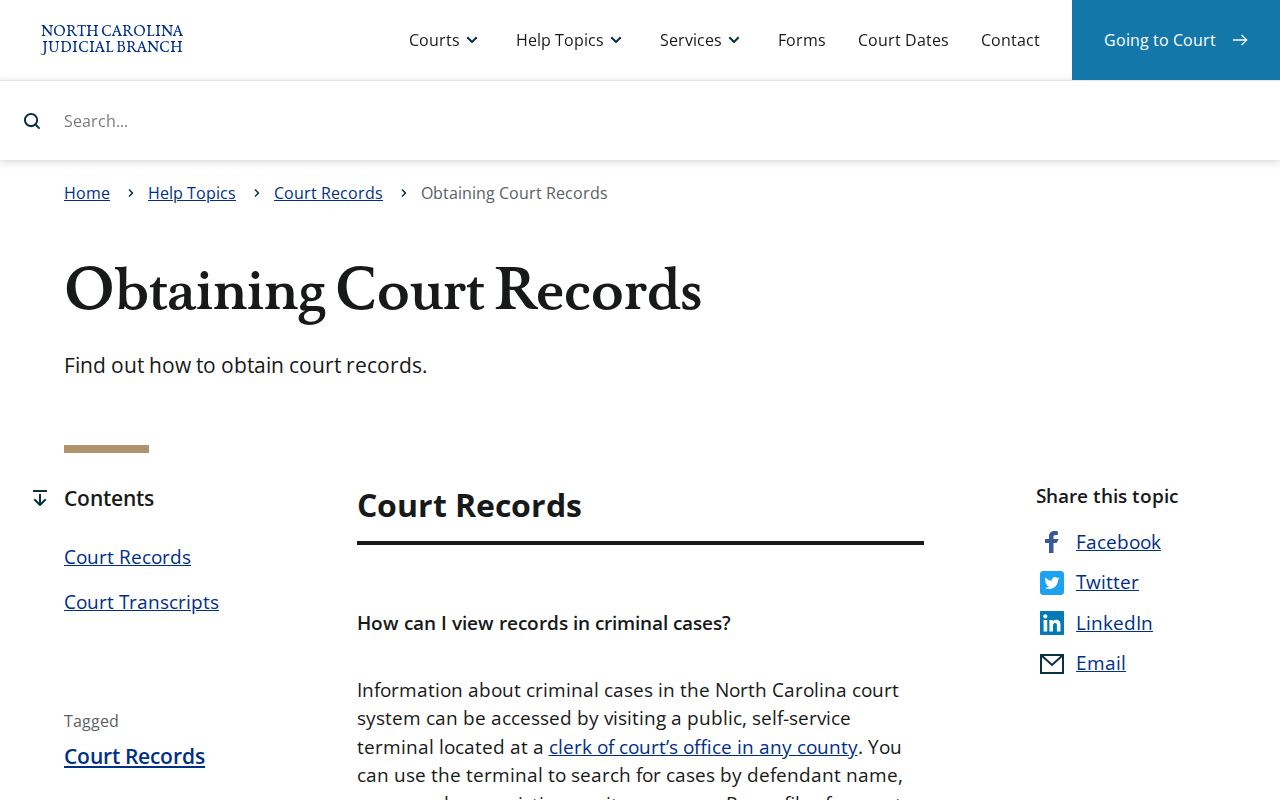
The access tiers help explain why an image may be absent online even when the Clerk can inspect or copy the underlying file.
What a Criminal Case File Contains
A Moore County case file records judicial activity, not just the arrest. The Portal's Register of Actions can display case summary, assignment information, parties, chronological events, dispositions, hearings, and financial information. Public document images may be viewed and printed at no charge. Exact content varies by case, and a financial entry can reflect costs without proving guilt.
| Case number and court | Identifies the file, location, and whether District or Superior Court holds the matter. |
|---|---|
| Charging material | Shows the allegations filed with the court, which may differ from the booking label. |
| Case events | Lists filed activity in time order, including process, motions, pleas, and post-judgment entries when public. |
| Hearings | Reports available scheduling information, judicial assignment, and courtroom data. |
| Disposition and judgment | States the court outcome, such as dismissal, not guilty, or guilty disposition. |
| Sentence and financials | May show sentence terms, costs, restitution, attorney fees, and supervision fees. |
A case file is broader than Moore Detention's public roster and different from an SBI fingerprint cycle. For the custody side of an event, the Moore County arrest search explains the jail and arresting-agency channels.
Certified Moore County Case Searches
Inspection and certification answer different needs. A reader can inspect public Portal records or use a terminal without buying a certified county search. When an official result is needed, the Moore Clerk uses form AOC-CR-314 and charges $25 for one county. That product is court-based. It is not a statewide SBI fingerprint history.
The Judicial Branch certified search instructions describe the Clerk process. The source view below reinforces the distinction between a free case lookup and a certified Clerk product.
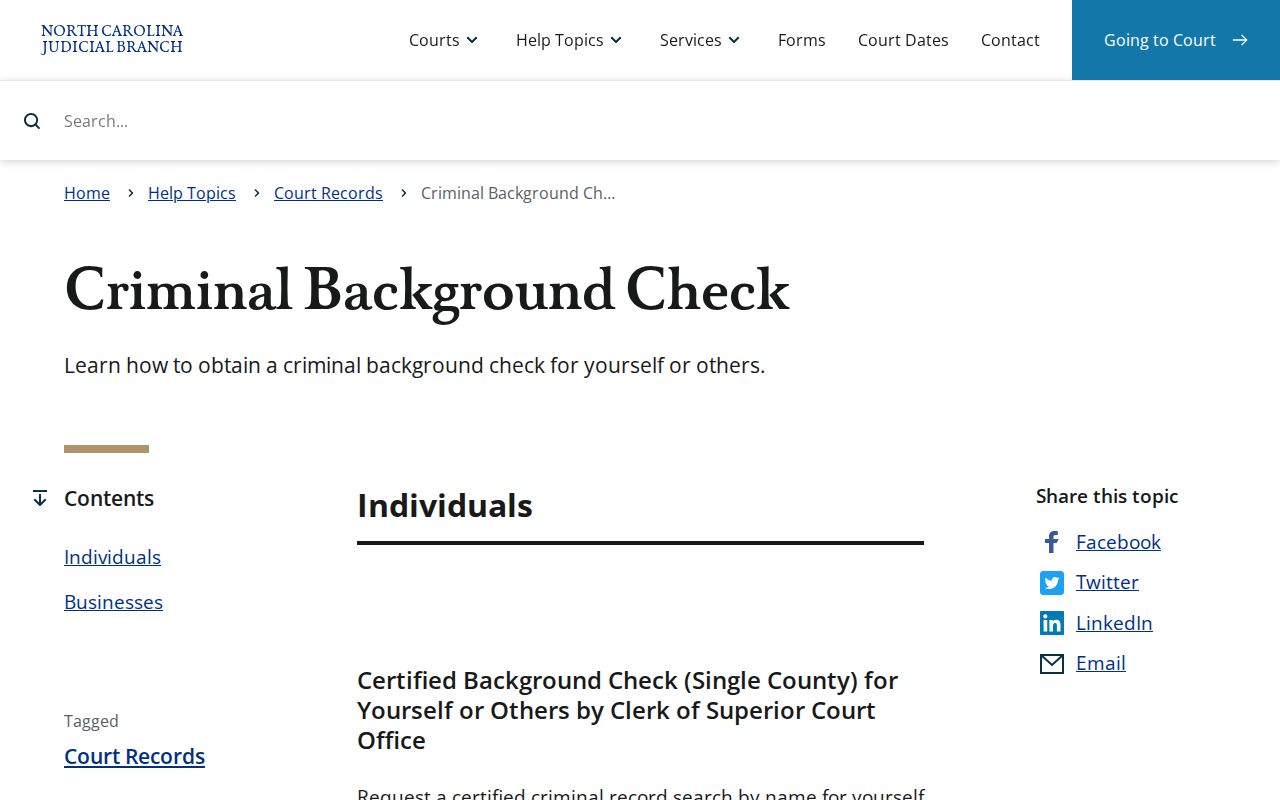
Mail requests require a money order or certified check, not a personal check. At the counter, the Clerk accepts cash, card, money order, or certified check, and card processing can add a charge.
Moore Clerk of Superior Court
102 Monroe Street
Carthage, NC 28327
Mail: PO Box 936
910-722-5000
Monday-Friday, 8 a.m.-5 p.m.
Criminal Case Stages in Moore County
A felony often starts with an arrest, a magistrate record, and preliminary District Court work before moving to Superior Court. A misdemeanor normally remains in District Court. The filed charge may change after the prosecutor reviews the event, and a plea or trial can produce a result different from the first booking label.
Case flow: Charges Filed › Arraignment › Pretrial › Plea or Trial › Disposition › Sentencing
Portal events should be read as a sequence. A case summary gives orientation, events show activity, hearings show scheduling, and dispositions state outcomes. Converted pre-launch events can carry a midnight timestamp that reflects migration rather than the true hearing time.
Moore County Counsel Field Trap
Moore County has no institutional public defender office. It operates under IDS Defender District 19D, with appointed counsel assigned through the local plan. That local fact makes the Portal's attorney field easy to misread. An attorney type that appears to suggest a public-defender assignment does not prove that a Moore public defender office handled the case.
Verify the named lawyer and appointment through the Moore Clerk at 910-722-5000. The District Attorney's office, at the courthouse and reachable at 910-722-5010, prosecutes the matter but does not replace the Clerk as record custodian. This check is most useful when the lawyer field appears inconsistent with the local defense structure.
Note: Counsel status and case outcome are separate facts; confirm each from the office that maintains that part of the record.
Moore County Court Payment Records
The Portal can accept eligible Moore County criminal costs and fees, restitution, attorney fees, and supervision fees. It does not accept cash bonds or forfeitures through that route. Visa, Mastercard, and Discover payments carry a 2.39% processing fee with a $1 minimum. That is a payment charge, not a fee to search case records.
The Moore County payment information page is the source for current channels and limits. Its official screen appears below.
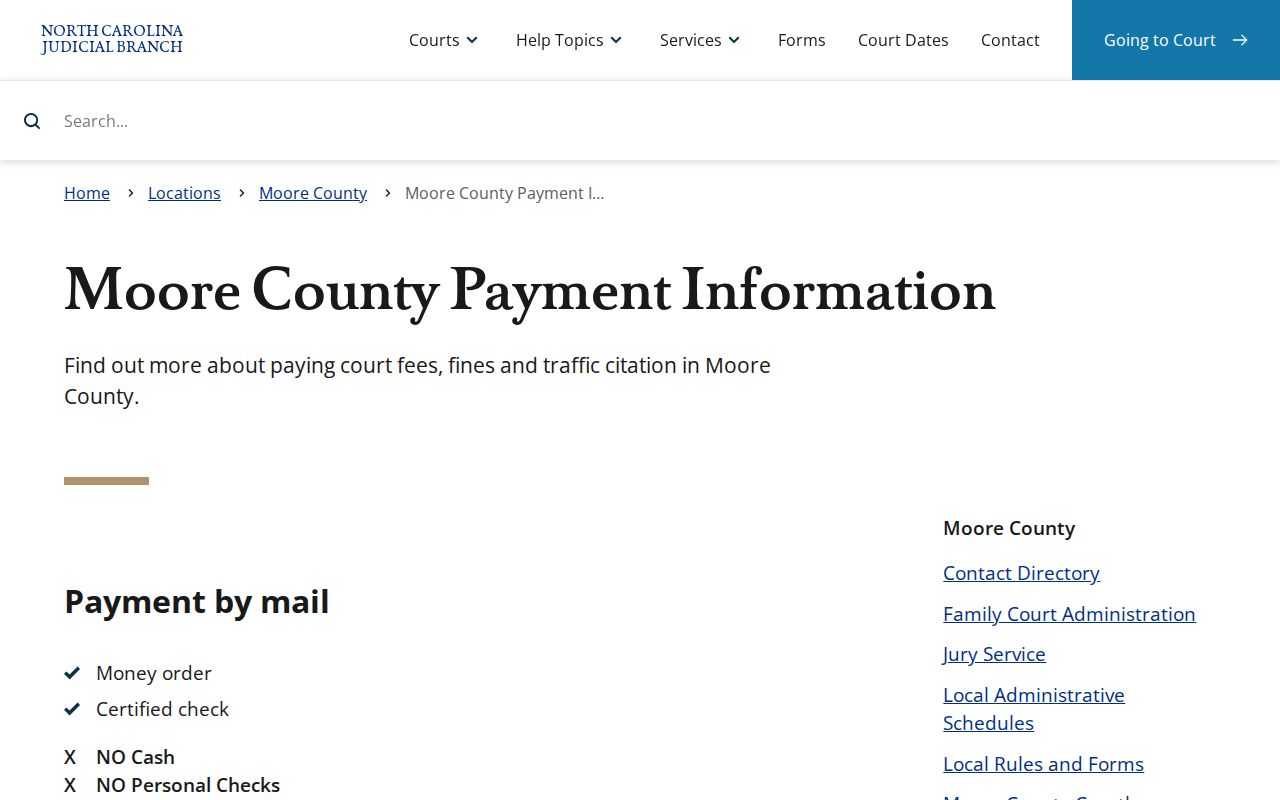
Read financial entries with care. A balance may reflect court costs or another obligation and does not, by itself, state the criminal disposition.
Access Rules for Case Records
G.S. 7A-109 directs clerks to permit inspection and copying unless a record is sealed or confidential. North Carolina's broader Public Records Law does not erase court-specific limits. Juvenile matters, sealed or expunged files, protective orders, and confidential identifiers can remain outside anonymous public access.
Unreturned warrants are restricted in eCourts. A Portal no-hit therefore does not clear a person of a warrant or prove that no proceeding exists. New summaries and public images often appear within minutes after Odyssey upload, but that timing is not a promise that every agency filing or old paper page has reached the system.
Access point: Portal is informational. Use the Moore Clerk for a certified record, an unavailable image, or a question about a restricted case category.
North Carolina SBI Right to Review serves a different purpose. It lets a person inspect their own fingerprint-supported statewide history by mail. A court file can exist without an SBI arrest entry, and an SBI cycle can lack a disposition if reporting is late. Comparing official sources is the sound way to resolve those gaps.